AI Summary
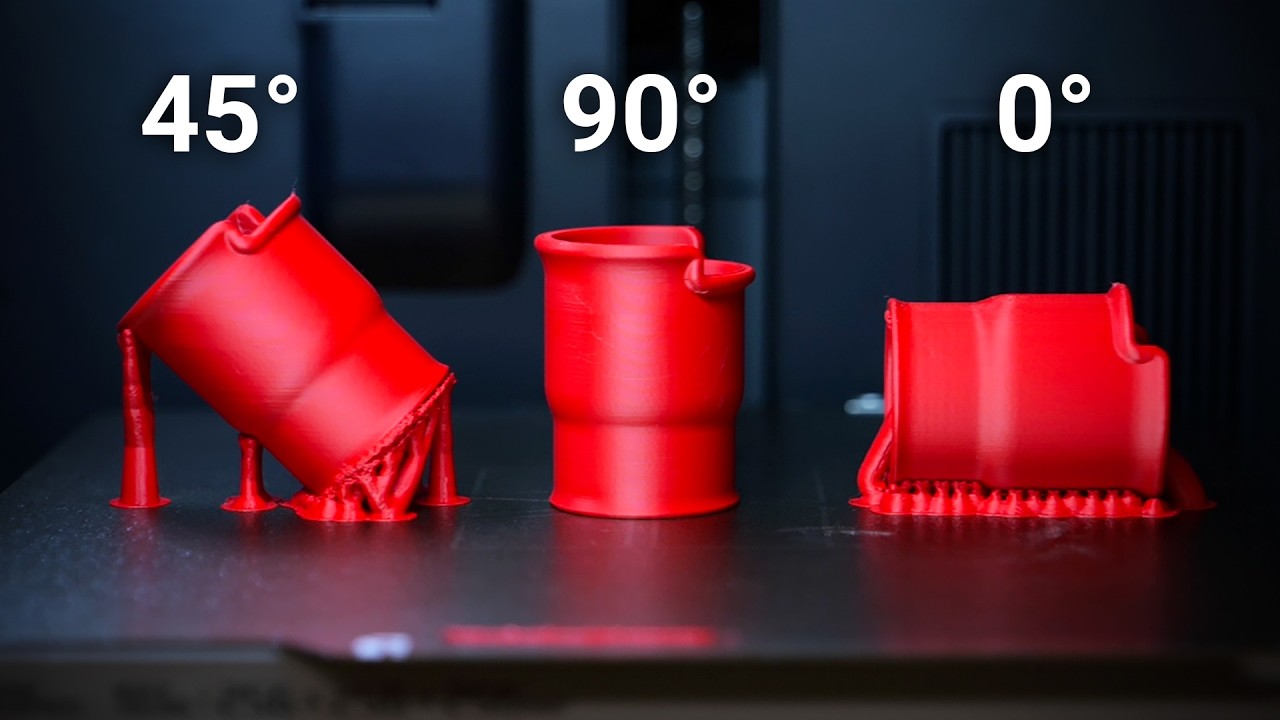
Stop Printing Flat: The 45° Secret for Stronger Parts
Full Summary
Key Quotes
« While many understand that layer adhesion is a common issue in 3D prints, few realize how much the performance of a part can vary depending on its orientation. »
Introduction to print orientation importance
« Anisotropic means that the properties of a material aren’t the same in every direction — and for FDM prints, that means they tend to break much easier if you pull the layers apart instead of along them. »
Explanation of anisotropic strength in FDM prints
« The horizontal samples had an average strength of 63 MPa, whereas the ones printed standing failed at only half the load, 31 MPa. »
Comparison of strength between flat and upright printed samples
« The 45° samples had a strength of 40 MPa. That’s still far from ideal, but angling the part improved strength by 27% compared to the vertical reference — which is significant. »
Strength improvement by printing at a 45° angle
« Printing a part at an angle isn’t always straightforward, though, because it often leads to minimal bed contact — in the case of the corner bracket, just a single point, which obviously won’t work. »
Challenges of angled printing regarding bed adhesion
Resources mentioned in the video
other
KiwiCo
Sponsor of the video, offering crates with hands-on projects for kids to learn science, engineering, and creativity.
tool
Prusa CORE One
A 3D printer used for testing and demonstrating print orientations.
other
Azurefilm Green PLA
A specific type of filament used in the tensile strength tests.
website
Slant3D channel
Mentioned for a video on designing custom supports.
other
Multiboard organization system
An example of a product design that uses clever splitting and bridging for efficient and strong printing.
other
3DBenchy
A common 3D printing test model used as an example to illustrate shrink lines.
Glossary
Print Orientation
The way a 3D model is positioned on the print bed before printing, significantly affecting part strength, appearance, and support material needs.
Layer Adhesion
The strength of the bond between successive layers of a 3D print. Poor layer adhesion is a common cause of part failure.
Anisotropic Strength
A material property where strength varies depending on the direction of the applied force. FDM 3D prints are typically weaker when pulled perpendicular to the layer lines.
Tensile Tester
A machine used to measure the strength and deformation of materials under tension, pulling them until they break.
Shrink Lines
Visible lines or notches on the surface of a 3D print caused by plastic shrinking as it cools, leading to deformation, especially on overhangs or where cross-sections change abruptly.
Community Reviews
Thanks for your review!
Frequently Asked Questions
Print orientation is crucial because it directly impacts the part's strength (due to anisotropic properties), surface appearance, and the amount of support material required. The default orientation in slicers often prioritizes printability over optimal strength.
3D prints are weakest when forces pull layers apart (perpendicular to layer lines) and strongest when forces run along the layer lines. Orienting the part so that critical stresses align with the print lines significantly increases its strength.
Printing at a 45° angle can offer a good compromise between strength and printability. It can significantly improve strength compared to printing vertically (layers perpendicular to stress) and can also improve surface appearance by reducing stair-stepping and shrink lines.
Printing at an angle can lead to reduced bed contact, requiring tricks like cutting a section of the model or adding brims/supports. It can also increase print time and may introduce new issues like warping or overhang problems if not managed correctly.
No, changing orientation doesn't always improve a part. While it can enhance strength and surface quality, it can also introduce new problems, shift failure points, or require significant compromises in other areas like support material or print time. Careful consideration of the specific part and its intended use is necessary.